Sajid Hameed
Ibne Safi's Jasoosi Duniya
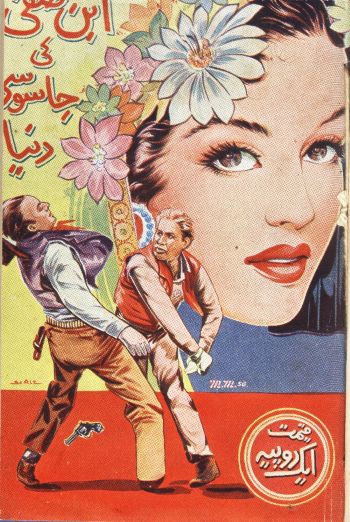 Sajid Hameed (Captain Hameed) is a fictional spy and crime-fighter, the chief assistant to Colonel Faridi in Ibne Safi’s Urdu series, Jasoosi Duniya. Hameed’s character complements that of Faridi’s. Hameed is playful, naughty, carefree, romantic, and when occasion calls for it, hardworking, brave, fearless, intelligent, and smart. Driven by his mood swings, he is also very unpredictable. He serves Faridi as his partner and assistant, and lives with him in the same mansion. Most of the time he acts like a child in front of Faridi, pretending to be a careless and messy character and frequently arguing with Faridi merely to irritate him. In his heart, however, he harbors a deep love for his boss. The fact that he is able to confront Faridi, which is not an easy task, is evidence of his strong character. Often it is Hameed’s seemingly impulsive actions that lead Faridi to victory.
Hameed is Jasoosi Duniya’s equivalent to Dr. Watson. Although he seems highly non-serious, he actually holds the same high standards of conduct as Faridi. On the surface, he seems to be complaining about and contradicting all that is good in Faridi – but that is just his style. Repeatedly we find him in situations where he acts just as one would expect Faridi to have reacted.
Hameed often jumps into action without thinking of the consequences, only to be surprised later on. Ibne Safi calls this condition “khopri pe chipkali sawar hona,” which literally means Hameed’s mental apprehension by a lizard. The lizard is used metaphorically as an object that irritates someone in an extreme fashion. Several of Hameed’s successes are a direct result of this phenomenon.
The novel Thandee Aag explains how and why Hameed’s personality has developed in this manner. Ibne Safi has given a complete psychological profile of Hameed in this story, and the reader can understand why he seems so mixed up and confused at times. Hameed’s father was a traditionally minded man who forced him to join the armed forces against his will. Hameed was consequently sent to join the Second World War at a very young age. Seeing the horrendous aftermath of war led him to take comfort in the influence of alcohol. As value for life diminished in his eyes and he started to ignore the importance of life, his carefree, somewhat irritated, and neglecting nature, developed. After meeting Faridi, Hameed’s philosophy on life changes dramatically to that which readers now know.
Hameed narrates to himself the story of how he met Faridi in Thandee Aag. Going through the horrors of war has left Hameed bitter and rebellious. He decides he will never go back home. At the end of the war, when the troops return, Hameed comes back too. At the train station, he sees his father waiting to receive him. Hameed tries to go past him without stopping, but his father jumps at him. He tries to hug him, but Hameed shrugs him off. He doesn’t allow his eyes to show any sign of recognition. He tells the old man that he is not his son, and that he has mistaken him for someone else. Hameed notices a tall good-looking man approaching in their general direction. Thus, Hameed runs to him and hugs him, saying affectionate brotherly words as if he has just seen his brother after a long time. The stranger, playing along, hugs him back and asks him how his journey was, telling Hameed that he was missed while he was away at the war front. The perplexed father cannot believe his eyes, but leaves due to this convincing show of drama. Later Hameed tells Faridi the whole story. Though Faridi disapproves of all this, he offers him a job as a police sergeant assisting him. Hameed agrees. Since he has nowhere else to go, he stays with Faridi. Later on, however, after being convinced by Faridi, Hameed goes back to his family and apologizes for the “joke” he pulled on his father.
Hameed also has strange hobbies. In some of the stories, he is found teaching his pet mouse how to dance. In other stories, he is teaching philosophy to his goat. Faced with a challenge, he never fails the expectations of his trainer and mentor, Faridi. Due to his natural flair for acting, he manages to dodge death many a time. A serious student of Faridi, Hameed is a master of disguise as well. Besides the usual plastic makeup, he keeps something in his pocket that he calls his “ready-made” makeup. These are two pieces of soft rubber springs, which when he inserts in his nostrils, make the nose lift up and hence move the upper lip to reveal the front teeth. This transformation of facial features leaves him hardly recognizable.
In his early days, Hameed is involved with a girl named Shehnaz. The affair develops to the point that Hameed is almost ready to propose. However, it is clear to the reader that the lovers are not fully matured and remain conflicted between the matters of heart and mind. Although it is necessary for the characters to go through such mental evolutionary processes, the nature of their relationship means that there could be no permanent rest. Hence, the character of Shehnaz is removed.